Every 60 seconds, a financial predator somewhere in the world is dialing an elderly person’s number. They are patient, they are practiced, and they know exactly which emotional buttons to push. According to the FBI’s Elder Fraud Report, older Americans lose more than $3.4 billion annually to elder fraud — a figure that grows every single year and, experts agree, represents only a fraction of actual losses.
Why? Because scams targeting the elderly are no longer clumsy, obvious schemes. Today’s con artists deploy sophisticated social engineering tactics — manufacturing urgent threats, exploiting deep trust, and weaponizing loneliness — against one of the most financially stable demographics in the country.
If you are a family member, caregiver, or a senior citizen yourself, this guide was written for you. We will walk through why older adults are disproportionately targeted, the most common scams you need to recognize today, step-by-step prevention strategies, and exactly what to do if someone you love has already been victimized. Protecting elderly people from scams is not a one-time conversation — it is an ongoing commitment, and it starts right here.
Why Are Senior Citizens Targeted by Scammers?

Understanding why scams target the elderly is the first step in stopping them. The answer is not simple — it sits at the intersection of psychology, sociology, and neuroscience.
Psychological and Emotional Factors
Many members of older generations were raised in a culture of inherent politeness and trust. Hanging up on someone mid-sentence, even a stranger, can feel genuinely rude. Financial predators targeting the aging population exploit this cultural trait ruthlessly, using high-pressure scripts that keep a victim engaged long enough to extract information or payment.
Social isolation and vulnerability to fraud are also deeply connected. Seniors who live alone, who have lost a spouse, or who have limited social networks are far more susceptible to the “grooming” tactics that scammers use to build false intimacy — sometimes over weeks or months.
Cognitive Decline and Susceptibility to Scams
Research consistently shows a link between age-related cognitive decline and an increased vulnerability to fraud. Changes in the prefrontal cortex — the region governing decision-making and skepticism — can make it genuinely more difficult to recognize a manipulative scenario in real time, even for highly intelligent individuals. This is not a character flaw; it is a neurological reality that families must acknowledge with compassion.
The Shame Barrier
Perhaps the most damaging obstacle to elder fraud protection is silence. Scam victim shame and embarrassment are pervasive. Many seniors who realize they have been deceived never tell a family member, fearing they will lose their independence or be seen as incompetent. This silence allows scams to continue — and allows criminals to remain free.
The Most Common Scams Targeting the Elderly

A. The Grandparent Scam
How it works: A senior receives a call — often late at night — from someone claiming to be a panicked grandchild. “Grandma, it’s me! I’m in jail and I need bail money right now. Please don’t tell Mom and Dad.” The emotional shock and urgency of the call bypasses rational thinking. The victim is then directed to wire money or purchase gift cards immediately.
The grandparent scam is particularly cruel because it exploits one of the most powerful human bonds that exists. Always establish a family code word that only real relatives would know for exactly this situation.
B. Phone & Government Impersonation Scams
How it works: The caller claims to be an IRS agent, Social Security administrator, or Medicare representative. They tell the senior that there is a warrant out for their arrest, that their benefits are about to be suspended, or that they owe an immediate debt. IRS phone scams targeting senior citizens frequently demand payment via wire transfer or untraceable gift cards — a method no legitimate government agency ever uses.
Remember this rule: The IRS, Social Security Administration, and Medicare will never call you demanding immediate payment or threatening arrest. Hang up.
C. Online Tech Support Scams
How it works: A frightening pop-up appears on a senior’s computer screen claiming their device has been infected with a dangerous virus. A prominent phone number is displayed. When called, the “technician” requests remote access to the computer — which they use to steal passwords, financial data, or to install actual malware. Tech support scams targeting older adults are among the fastest-growing categories of internet scams for the elderly.
D. Online Romance Scams
How it works: A sophisticated, well-crafted fake profile appears on a dating app or social media platform. The scammer — often operating from overseas — spends weeks or months building a genuine emotional connection. Romance scams targeting seniors are particularly insidious because the “grooming” process creates real feelings of love and trust. Then the financial crisis arrives: a medical emergency, a business deal gone wrong, a plane ticket needed urgently. The victim, now emotionally invested, sends money willingly.
Online romance scams targeting elderly women in particular are epidemic, though men are also frequently victimized.
E. Sweepstakes, Lottery & Investment Scams
How it works: A letter, email, or call informs the senior that they have won a foreign lottery or sweepstakes they never entered. To claim the winnings, they must first pay a “tax” or “processing fee.” The fees grow endlessly, and the winnings never arrive. Separately, investment scams preying on retired seniors often arrive dressed up as “exclusive opportunities” with guaranteed returns — a promise that no legitimate investment can ever make.
F. Home Repair & Charity Scams
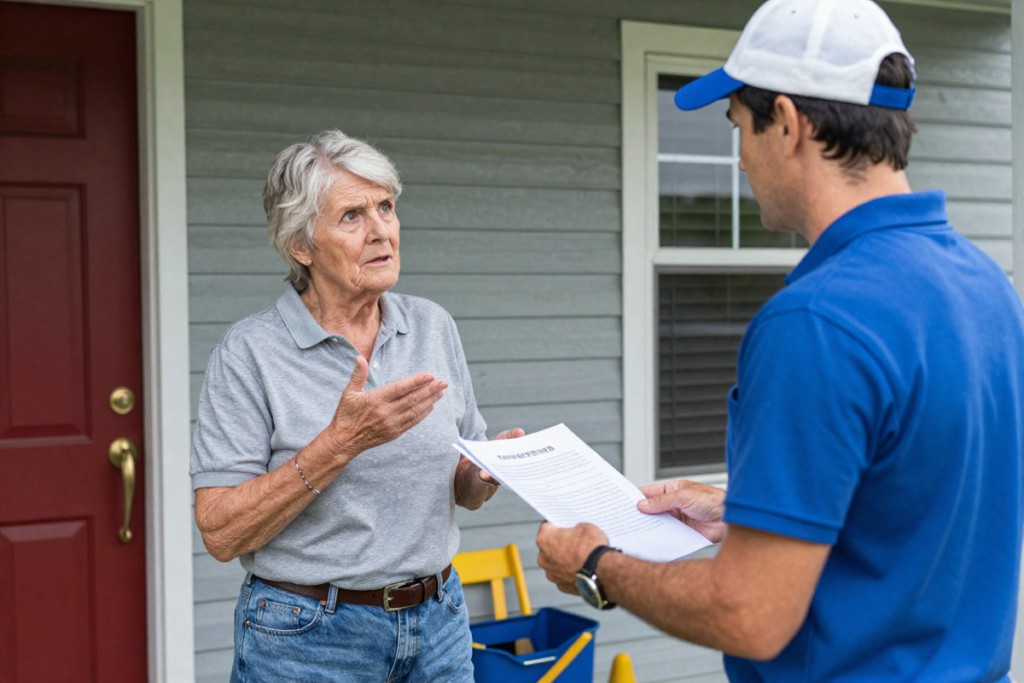
How it works: Door-to-door fraudsters knock on seniors’ doors offering to fix a roof, seal a driveway, or trim a tree for an unusually low price. They collect a large cash deposit upfront and disappear, or perform shoddy, unnecessary work. Home repair scams that target senior citizens spike significantly after major storms and natural disasters when genuine repair needs are high.
Charity scams targeting elderly donors operate similarly, using fake organizations that mimic the names of legitimate charities during disaster relief periods or holiday seasons. Always verify a charity at Charity Navigator or Give.org before donating.
Warning Signs: How to Tell If an Older Adult Is Being Scammed

Knowing the red flags that an older person is being financially exploited could save a life’s worth of savings.
Behavioral Red Flags
- Sudden unexplained secretiveness about phone calls or mail
- Unusual anxiety or fear when the phone rings
- Mentions of a new “friend” or “investment advisor” you’ve never heard of
- Confusion or inconsistency when discussing recent financial decisions
- Withdrawing from family conversations, especially about money
Financial Red Flags
- Large, unexplained ATM withdrawals or wire transfers
- New credit card accounts or loans in the senior’s name
- Unpaid bills despite adequate income — money is going somewhere else
- Missing estate planning documents, wills, or financial account statements
- Checks made out to unfamiliar individuals or companies
Signs Your Elderly Parent Is Being Scammed by a Caregiver
Elder financial abuse committed by a trusted caregiver or even a family member is tragically common. Watch for caregivers who isolate the senior from other family members, insert themselves into financial conversations, or are added to bank accounts without the senior’s fully informed consent. If you are monitoring elderly parents’ finances and see unexplained transfers benefiting a caregiver, act immediately.
Step-by-Step Prevention: How to Protect Seniors from Fraud

This is the most important section in the guide. These are concrete, actionable steps that anyone can implement today.
Step 1: Secure the Phone Lines
The phone remains the single most common tool used in scams targeting the elderly. Start here.
- Register for the Do Not Call Registry at DoNotCall.gov (1-888-382-1222). While it will not stop criminal scammers who ignore the law, it reduces unwanted solicitation calls significantly.
- For landlines, consider installing a dedicated call-blocking device that automatically intercepts known scam numbers before the phone even rings.
- For smartphones, enable the built-in spam call filtering available on both iOS and Android, and consider a dedicated call-blocking app.
📌 [Top-rated call-blocking hardware devices for landlines — CPR Call Blocker]
📌 [Best call-blocking apps for smartphones — Nomorobo, Hiya]
Step 2: Scam-Proof the Computer and Email
Phishing emails targeting seniors are designed to look exactly like legitimate correspondence from banks, Medicare, or the IRS. Teaching basic digital safety for older adults requires patience, but the basics are straightforward:
- Never click links in unsolicited emails. Go directly to the company’s website by typing the address manually.
- Enable spam filtering on all email accounts, set to the highest sensitivity level.
- Keep software and operating systems fully updated to close known security vulnerabilities.
- Install a reputable antivirus program and keep it active.
For comprehensive protection, a full-service identity theft protection service monitors the dark web, credit profiles, and financial accounts — sending real-time alerts if a senior’s personal information appears somewhere it shouldn’t.
📌 [Antivirus/cybersecurity software — Norton 360 or Bitdefender]
Step 3: Safeguard Bank Accounts and Credit
Knowing how to protect elderly parents’ bank accounts from fraud requires taking proactive financial steps now, before a scam occurs.
- Place a Credit Freeze with all three major credit bureaus — Equifax, Experian, and TransUnion — at no cost. A freeze prevents new credit lines from being opened in the senior’s name without explicit authorization.
- Set up fraud alerts directly through your bank. Most institutions now allow family caregivers to receive duplicate statements or transaction notifications.
- Consider a dedicated financial monitoring service built specifically for aging adults and their families. These platforms track spending patterns and flag unusual activity automatically.
📌 [Financial monitoring software designed for family caregivers — Carefull]
Step 4: Establish Legal & Banking Protections
Some of the most powerful tools for protecting aging parents from financial fraud are legal and institutional — and they cost very little to set up.
- Designate a Trusted Contact Person at the bank. Under FINRA rules, banks can now contact a designated family member if they suspect a senior customer is being financially exploited. This does not give the contact control over the account — it simply creates a communication channel.
- Establish a Financial Power of Attorney (POA). A durable financial POA allows a trusted family member to step in and manage financial decisions if the senior becomes incapacitated or is actively being manipulated. Consult an elder law attorney to set this up correctly. The Senior Safe Act also provides legal protections for financial institutions that report suspected elder financial exploitation in good faith.
The Family Conversation: How to Talk to Aging Parents About Scams

One of the most common questions caregivers ask is: “How do I explain to my aging parent that they are being scammed?” It is a delicate conversation, and approach matters enormously.
Overcoming Resistance
Never frame the conversation as “You almost got scammed because you’re getting older.” This triggers defensiveness and shame. Instead, lead with empathy: “These criminals are professionals — they trick people of all ages, and they’ve gotten incredibly sophisticated. I want to show you what they’re doing so we can protect our whole family.”
Educational Strategies
Frame new habits as “digital safety rules” rather than restrictions on their independence. Practice specific scenarios together: “If someone calls claiming to be from the IRS, here’s exactly what we’re going to say.” Role-playing defuses the emotional charge of a real call.
Handling Active Denial
If a parent is currently being scammed and refuses to believe it, avoid ultimatums. Instead, try: “I’m not saying you made a mistake. I’m saying this person is very, very good at what they do — and I found information that shows this exact story is being used to steal money from people all over the country. Can we look at it together?” If denial continues and money is at risk, contacting Adult Protective Services for a wellness check is a legitimate option.
Crisis Management: What to Do If Your Parent Was Scammed

If you discover that an elderly parent has been scammed, speed is critical. Here is what to do immediately.
Immediate Mitigation Steps
- Contact the bank immediately. Ask to speak with the fraud department. If money was wired in the last 24–72 hours, there is a chance — not a guarantee, but a chance — that the transaction can be halted or reversed. Act within hours, not days.
- Freeze all compromised accounts and credit profiles at all three bureaus if personal information was shared.
- Collect all evidence: call records, gift card receipts, wire transfer confirmations, email screenshots. You will need these when filing reports.
- Do not shame the victim. Your parent needs support, not judgment. Emotional recovery after being scammed is a real process that takes time.
Reporting to Authorities
Filing reports is critical — both to potentially recover funds and to stop these criminals from victimizing others.
| Agency | What They Handle | How to Contact |
|---|---|---|
| National Elder Fraud Hotline | Dedicated elder fraud support | 1-833-FRAUD-11 |
| FTC (Federal Trade Commission) | Consumer fraud reports | ReportFraud.ftc.gov |
| FBI’s IC3 | Internet/cyber crime | IC3.gov |
| Adult Protective Services (APS) | Local elder abuse intervention | Contact your state’s APS office |
| Consumer Financial Protection Bureau | Financial product fraud | ConsumerFinance.gov |
Legal and Recovery Realities
Can you get money back after an elderly parent has been scammed? The honest answer is: sometimes, but recovery is difficult, especially for wire transfers and gift card payments. However, it is never impossible. An elder law attorney can advise on civil remedies for elder fraud, including civil lawsuits against perpetrators if they are identified. The Elder Justice Act and Senior Safe Act provide federal frameworks for protecting and supporting elderly fraud victims.
Conclusion & Quick Prevention Checklist
Protecting elderly people from scams is not a single conversation — it is an ongoing protective practice. And as this guide has shown, the best defense is always proactive rather than reactive. Scammers are agile, creative, and relentless. Our response must be equally committed.
Print or bookmark this Quick Prevention Checklist:
✅ Registered for the Do Not Call Registry ✅ Call-blocking technology installed on all phones ✅ Credit freeze placed with all three bureaus ✅ Fraud alerts active on all bank accounts ✅ Identity theft protection service enrolled ✅ Trusted Contact Person designated at the bank ✅ Financial Power of Attorney established ✅ Family “safe word” established for grandparent scam scenarios ✅ Emergency reporting contacts saved (National Elder Fraud Hotline: 1-833-FRAUD-11)
Share this guide with every caregiver and family member you know. The more people who understand these tactics, the harder it becomes for financial predators to succeed.
Frequently Asked Questions

What are the most common scams targeting the elderly? The most common scams targeting the elderly include the grandparent scam, government impersonation scams (fake IRS/SSA calls), tech support scams, online romance scams, lottery and sweepstakes fraud, and home repair scams. Phone-based and internet scams are the most frequently reported categories.
How can I protect my elderly parents from phone scams? Register their number with the Do Not Call Registry, install a call-blocking device or app, and establish clear household rules: never wire money or buy gift cards based on a phone request, and always call a known family member to verify any emergency claim before taking action.
Can a bank reverse a transaction if an elderly person was scammed? Banks can sometimes reverse wire transfers if contacted within 24–72 hours of the transaction. Gift card payments and cash transactions are nearly impossible to recover. Contact the bank’s fraud department immediately — every hour matters.
Where do I report a scam against an elderly person? Report to the National Elder Fraud Hotline (1-833-FRAUD-11), the FTC at ReportFraud.ftc.gov, the FBI’s IC3 at IC3.gov, and your local Adult Protective Services office. File reports with all agencies for maximum impact.
Should I get power of attorney to protect my parent from financial fraud? A durable financial Power of Attorney is one of the most effective legal tools for protecting an aging parent from financial exploitation. It allows a trusted family member to intervene on their behalf if they are being manipulated or become incapacitated. Consult an elder law attorney to ensure it is set up correctly and to reflect your parent’s wishes.
Disclaimer: This article contains affiliate links. If you purchase an item through the link I will earn a small commission at no extra cost to you.
No Responses